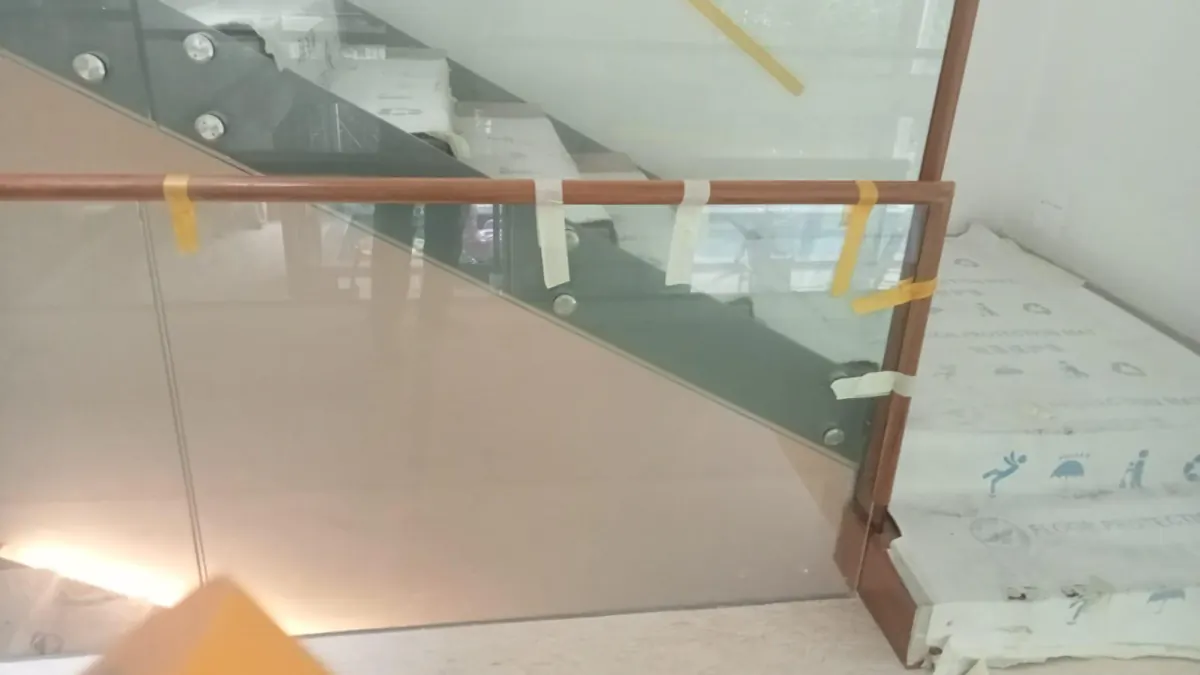
Glass Interlayer
Calculator
Compare PVB and SGP interlayer performance for laminated glass installations. Based on the Wölfel–Bennison equivalent thickness method and ASTM E1300 load resistance principles, with full academic citations.
Input Parameters
Typical Singapore wind loads: 1.0–2.2 kPa depending on building height and zone.
Calculation Results
The design is conservative with adequate safety margin. Suitable for the specified load.
How the Calculator Works
Wölfel–Bennison Equivalent Thickness
Laminated glass behaves as a composite plate whose stiffness depends on the interlayer's ability to transfer shear between glass plies. The equivalent thickness method converts the laminate into a monolithic plate of equal bending stiffness.
where z = (h₁+h₂)/2 + t_pv
Γ (gamma) = 0.08 for PVB, 0.82 for SGP. Source: Wölfel & Bennison (2001).
Plate Theory Load Analysis
Once equivalent thickness is established, the panel is analyzed as a simply-supported rectangular plate under uniform pressure using coefficients derived from Timoshenko plate theory.
σ_max = β · q · a² / h²
α and β are tabulated coefficients based on aspect ratio. Source: Timoshenko & Woinowsky-Krieger (1959).
Safety Factor Verification
The calculated maximum stress is compared against the characteristic bending strength of tempered glass, adjusted for surface condition and load duration.
f_k = 120 MPa (tempered)
A factor of safety ≥ 2.5 is recommended for permanent glazing installations.
Singapore Standards Alignment
Wind loads follow SS EN 1991-1-4 with Singapore National Annex. The calculator applies a simplified pressure model based on building height zones common in local practice.
V_b = 24–28 m/s (Singapore)
Source: SS EN 1991-1-4 Singapore National Annex.
PVB vs SGP Properties
| Property | PVB | SGP | Unit |
|---|---|---|---|
| Shear transfer coefficient (Γ) | 0.05 – 0.15 | 0.60 – 0.90 | — |
| Shear modulus (20°C) | 0.5 – 2.0 | 80 – 120 | MPa |
| Tensile strength | 20 – 25 | 35 – 40 | MPa |
| Tear strength | ~20 | ~100 | N/mm |
| Stiffness contribution | Low — plies act independently | High — near-monolithic | — |
| Moisture resistance | Moderate — edge delamination risk | Excellent — minimal edge degradation | — |
| Acoustic damping | Excellent | Moderate | — |
| Typical relative cost | 1.0× (baseline) | 2.5 – 4.0× | — |
Values are representative ranges for architectural glazing interlayers at room temperature under short-duration load. Source: Bennison et al. (1999), Kuraray SentryGlas technical datasheet, Saflex PVB technical datasheet.
Academic Citations
Wölfel, E. & Bennison, S. (2001). "The Lamination of Flat Glass — A Method for the Determination of the Effective Thickness." Proceedings of Glass Processing Days, Tampere, Finland.
View sourceASTM E1300-22 (2022). "Standard Practice for Determining Load Resistance of Glass in Buildings." ASTM International, West Conshohocken, PA.
View sourceSS EN 16612:2019 (2019). "Glass in building — Determination of the load resistance of glass panes by calculation and testing." Singapore Standards Council.
Behr, R.A., Minor, J.E. & Linden, M.P. (1986). "Laminated Glass Units Under Uniform Lateral Pressure." Journal of Structural Engineering, ASCE, 112(8), pp. 1803–1821.
View sourceBennison, S.J., Jagota, A. & Smith, C.A. (1999). "Fracture of Glass/Polyvinyl-Butyral (Butacite®) Laminates in Biaxial Flexure." Journal of the American Ceramic Society, 82(7), pp. 1761–1770.
View sourceTimoshenko, S. & Woinowsky-Krieger, S. (1959). "Theory of Plates and Shells." 2nd ed., McGraw-Hill, New York.
Ezzogenics Pte Ltd (2025). "PVB vs SGP Glass Interlayer Calculator — Open Source Engineering Tool." GitHub Repository, MIT License.
View sourceOpen-Source Engine
This calculator is powered by the open-source PVB vs SGP Glass Interlayer Calculator engine developed by Ezzogenics Engineering and released under the MIT License. The full source code, engineering datasheet tables, and methodology writeup are available on GitHub.
Need Structural Glass Advice?
This calculator provides preliminary estimates. For certified structural glazing design, consult our engineering team for project-specific calculations and BCA submission support.